
WoF, CoF, rego and RUC compliance for NZ fleets
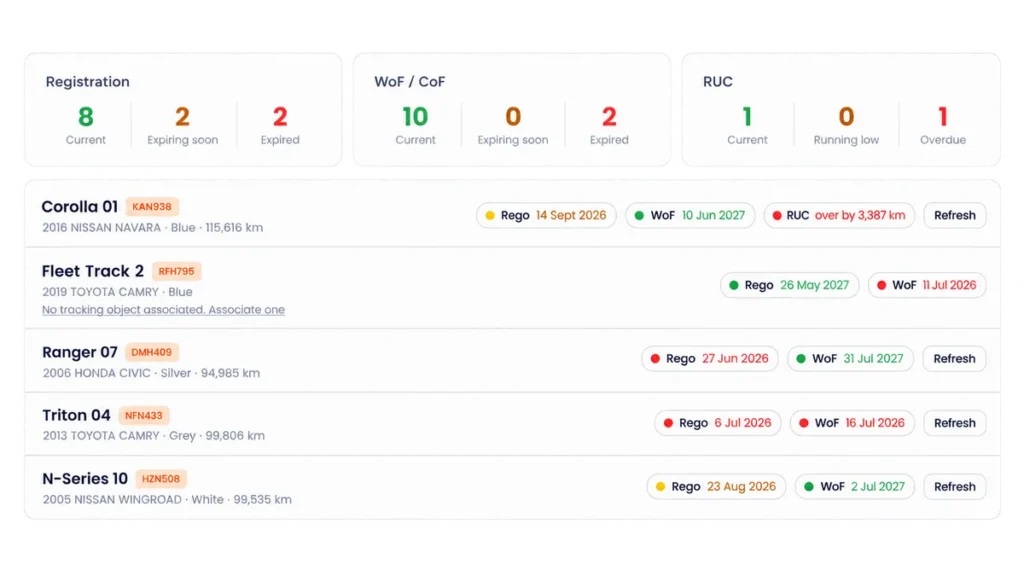
Fleet Compliance checks every vehicle against the NZ motor vehicle registry and its live odometer, and tells you before a rego, WoF, CoF or RUC licence lapses. It’s built into Fleet Track, alongside live GPS tracking, trips and alerts.
WoF rules change on 1 November 2026
Longer WoF intervals for many vehicles, a new check for driver-assist warning lights, and NZTA says the fee for a WoF more than two months out of date rises to $350.
Three things expire on every vehicle. Fleet Compliance tracks all three.
Registration
Rego expiry dates straight from the NZ motor vehicle registry, including vehicles on hold or with a lapsed licence. Renewals are picked up without anyone updating anything.
WoF and CoF
Inspection due dates for light and heavy vehicles, and failed inspections too, so a vehicle that failed and never went back doesn’t slip through.
RUC
Kilometres left on each RUC licence, worked out from the vehicle’s live odometer, with a projected run-out date. Overruns are flagged in kilometres.
Compliance that runs itself when it's part of Fleet Track
Fleet Compliance works on its own, but inside Fleet Track your trackers do the work of keeping it accurate.
RUC from the GPS odometer
Your trackers report each vehicle’s odometer, so RUC balances stay right without anyone reading the dash.
Off-road RUC evidence
Set up farms, forestry blocks and quarries as geofences. Trip and geofence reports give time-stamped records with odometer readings to support a refund claim.
Maintenance and costs
Service reminders by distance, engine hours or date, with every cost recorded against the vehicle.
Next to the live map
Compliance status sits in the Fleet Track portal and app, beside live tracking, trips and alerts, in one account.
Set up once, then stop chasing dates
Your vehicles, looked up
Each plate is looked up in the registry, and the make, model, colour and every expiry date fill in. Nothing to key in twice.
The right people told
Reminders go to you, your office manager or the driver of that vehicle, by email and in the portal and app, before each date comes up.
Proof when you need it
The registry is rechecked on a schedule. When a client, auditor or insurer asks, download a one-page report for the whole fleet.
WoF changes from 1 November 2026: what fleet operators need to know
The Government is changing how often light vehicles need a WoF, and NZTA is raising some fees. Here’s what changes and what it means for a business fleet.
| Vehicle | Now | From 1 November 2026 |
|---|---|---|
| New vehicles | Second WoF at 3 years | Second WoF at 4 years |
| 4 to 14 years old | WoF every year | WoF every 2 years, phased in (see below) |
| 14 to 26 years old | WoF every year | WoF every year (no change) |
| Registered before 1 January 2000 | WoF every 6 months | WoF every year |
| Light rental service vehicles | CoF A every 6 months | CoF A every year |
It’s phased in. Vehicles registered on or after 1 November 2019 move to two-yearly WoFs from 1 November 2026. Vehicles registered between 1 November 2013 and 31 October 2019 move from 1 November 2027. Current WoF and CoF A expiry dates stay the same; the new interval starts at the vehicle’s next inspection.
New check at inspection. WoF and CoF A inspections will also check that no warning lights are showing for driver-assist systems such as Lane Keep Assist and Automatic Emergency Braking.
Higher fees. NZTA says the fee for a light vehicle with a WoF more than two months out of date rises from $200 to $350, and for non-compliant tyres from $150 to $350.
What it means for your fleet
- Your fleet ends up on mixed intervals: some vehicles yearly, some two-yearly, older ones moving from six-monthly to yearly. A spreadsheet or diary gets harder to keep right.
- Longer gaps between inspections put more weight on keeping vehicles safe in between.
- Letting a WoF lapse costs more from 1 November.
Fleet Compliance reads each vehicle’s actual due date from the registry, so the new intervals are picked up automatically.
Sources: NZTA: changes to WoF and CoF A from 1 November 2026, NZTA: changes to light vehicle inspections and the Government’s WoF and CoF reform Q&A. Checked 28 September 2026.
What a lapsed rego, WoF or RUC licence costs a business
Infringement fees apply per vehicle, and some are higher for companies. Figures from the regulations on legislation.govt.nz and NZTA, as at September 2026.
| What happens | Infringement fee | Source |
|---|---|---|
| Operating a vehicle without a valid RUC licence | $400 for an individual, $800 for a company | RUC infringement regulations |
| Going over the distance on a light vehicle’s RUC licence | $200 | RUC infringement regulations |
| Failing to keep a vehicle licensed (rego) | $200 for an individual, $1,000 for a company | Registration and licensing regulations |
| Driving an unlicensed vehicle | $100 | Registration and licensing regulations |
| Operating a light vehicle with a WoF more than 2 months out of date | $200, rising to $350 from 1 November 2026 (NZTA) | NZTA |
| Non-compliant tyres or wheels | $150, rising to $350 from 1 November 2026 (NZTA) | NZTA |
RUC for business fleets
Light diesel vehicles and EVs up to 3,500 kg pay $76 per 1,000 km, and plug-in hybrids $38 (RUC rates regulations). A bill before Parliament would allow all vehicles, including petrol, to move to RUC in future; no date has been set (Land Transport (Revenue) Amendment Bill).
A vehicle is a workplace
Under the Health and Safety at Work Act 2015, a workplace includes a vehicle. WorkSafe has said companies must ensure their fleets are properly maintained; in that 2019 case a transport company was fined $150,000.
Don't need GPS tracking?
fleetcompliance.nz is the compliance-only version of Fleet Track. It works from number plates alone, and if you add tracking later it turns on in the same account.
Fleet Compliance questions
In Fleet Track, Fleet Compliance works alongside your trackers, which keep RUC balances up to date from each vehicle’s odometer. If you only want compliance reminders, fleetcompliance.nz works from number plates alone.
Rego, WoF and CoF dates and inspection results come from the NZ motor vehicle registry and are rechecked on a schedule. Odometer readings come from your Fleet Track trackers, so RUC kilometres remaining stay current.
You choose: yourself, your office manager, or the driver of that vehicle. Reminders come by email and show in the Fleet Track portal and app.
Yes. Fleet Compliance tracks WoF and CoF inspection dates for light and heavy vehicles, along with rego and RUC.
Most light vehicles between 4 and 14 years old move to a WoF every two years (phased in from 1 November 2026 and 1 November 2027), new vehicles get their second WoF at 4 years, and vehicles registered before 2000 move from six-monthly to yearly. NZTA also says the fee for a WoF more than two months out of date rises to $350.
It helps you build the evidence. Set up your off-road areas (farms, forestry blocks, quarries) as geofences, and the trip and geofence reports give you time-stamped records with odometer readings to support a refund claim.
Yes. Download a one-page report showing the rego, WoF, CoF and RUC status of the whole fleet.