From 1 November 2026, New Zealand’s warrant of fitness rules change. Many light vehicles move to a WoF every two years, older vehicles need them less often, inspections add a new check, and NZTA says the fee for driving on an expired WoF goes up. If you run work vehicles, here’s what changes and what to do about it.
What’s changing
| Vehicle | Now | From 1 November 2026 |
|---|---|---|
| New vehicles | Second WoF at 3 years | Second WoF at 4 years |
| 4 to 14 years old | WoF every year | WoF every 2 years (phased in, see below) |
| 14 to 26 years old | WoF every year | No change |
| Registered before 1 January 2000 | WoF every 6 months | WoF every year |
| Light rental service vehicles | CoF A every 6 months | CoF A every year |
The WoF changes cover light vehicles, including cars, vans, people-movers and trailers, but not agricultural vehicles (NZTA).
When it starts for your vehicles
The move to two-yearly WoFs is phased by registration date:
- Vehicles first registered on or after 1 November 2019 move to two-yearly WoFs from 1 November 2026.
- Vehicles registered between 1 November 2013 and 31 October 2019 move from 1 November 2027.
Your vehicles’ current WoF and CoF A expiry dates don’t change. The new interval applies from each vehicle’s next inspection (NZTA).
A new check at inspection
WoF and CoF A inspections will also check that no warning lights are showing for driver-assist systems such as Lane Keep Assist and Automatic Emergency Braking (NZTA). If your fleet includes newer utes and vans with these systems, a warning light could now mean a failed inspection.
Higher fees for letting it lapse
NZTA says that from 1 November 2026:
- The infringement fee for operating a light vehicle with a WoF more than two months out of date rises from $200 to $350.
- The fee for non-compliant tyres or wheels rises from $150 to $350, with a maximum court-ordered fine of $1,000.
These are per vehicle, so a few lapsed WoFs across a fleet add up quickly.
What it means for a business fleet
- Mixed intervals. Depending on age and registration date, your vehicles will be on different cycles: some yearly, some two-yearly, older ones moving from six-monthly to yearly, and some switching in 2027. A spreadsheet or calendar gets harder to keep right.
- More time between inspections. With longer gaps, keeping vehicles safe between WoFs matters more. The Government’s changes put more responsibility on drivers to maintain their vehicles (NZTA).
- Your duty of care stays the same. Under the Health and Safety at Work Act 2015, a workplace includes a vehicle, and WorkSafe has said companies must ensure their fleets are properly maintained.
How to stay on top of it
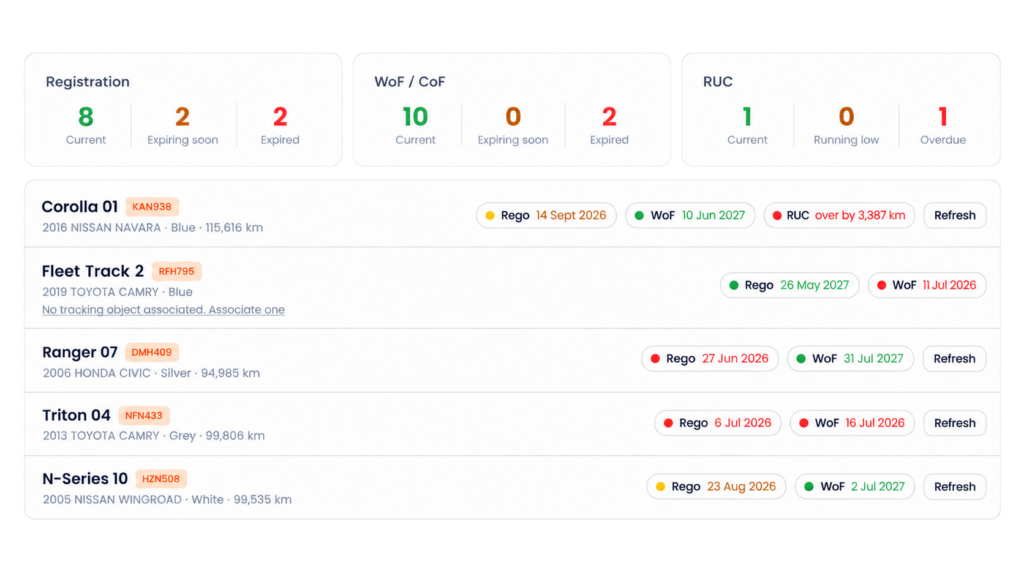
The simplest fix is to stop tracking dates by hand. Fleet Compliance, built into Fleet Track, reads each vehicle’s actual WoF, CoF and rego dates from the NZ motor vehicle registry and reminds you or your team before anything lapses, so the new intervals are picked up automatically. It tracks RUC too, using each vehicle’s live odometer from your Fleet Track trackers.
Want to see it on your own fleet? Get in touch and we’ll show you.
Sources
- NZTA: Changes to WoF and CoF A from 1 November 2026
- NZTA: Changes to light vehicle inspections from 1 November 2026
- Government Q&A: WoF and CoF reforms (April 2026)
Checked 28 September 2026. Rules and fees can change; check NZTA for the latest.